Subterranean termite soil remediation functions by establishing an uninterrupted zone of treated earth that worker termites cannot detect, cross, or exploit. In South Texas, the native subterranean termite (…
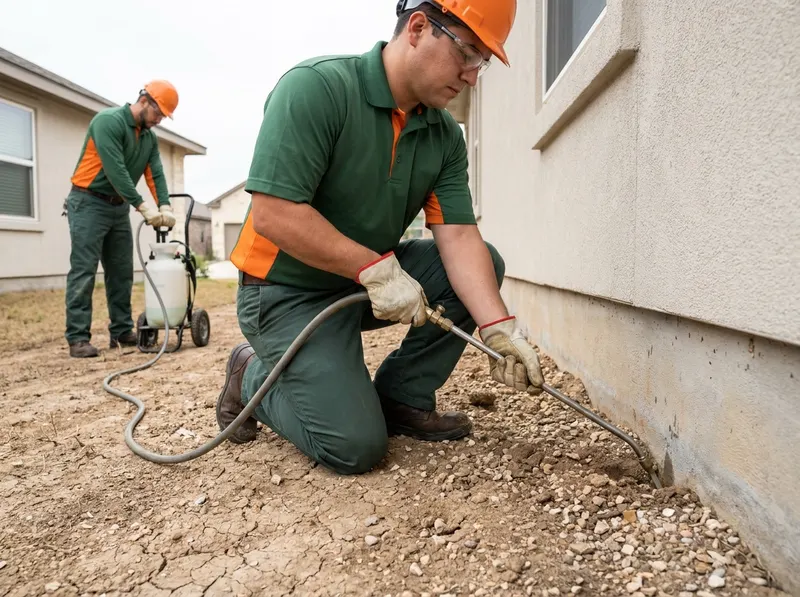
Subterranean termite soil remediation functions by establishing an uninterrupted zone of treated earth that worker termites cannot detect, cross, or exploit. In South Texas, the native subterranean termite (Reticulitermes flavipes) and the Formosan subterranean termite (Coptotermes formosanus) depend on soil moisture to survive, as cataloged by the Texas A&M Department of Entomology. These colonies construct vertical mud tubes upward along foundation stem walls to access structural cellulose framing. When a structure sits atop the active, expansive clay soils documented by the USDA Natural Resources Conservation Service throughout northern Bexar County, foundation shifting creates structural expansion gaps. A continuous liquid chemical barrier stops this subterranean cycle: worker termites pass through treated soil particles, ingest the non-repellent compound, and unknowingly transfer active molecules throughout the reproductive colony via trophallaxis before foraging lines collapse.
Subterranean remediation is required when an inspection confirms active structural mud tubes or subterranean colony pressure along slab perimeters. For localized surface activity isolated to non-structural timber, localized drywood foaming or surface borate applications may suffice, but those methods leave ground nesting colonies free to re-enter. The operational trade-off of whole-perimeter soil remediation is physical disruption: creating an continuous zone requires trenching alongside landscaping beds, lifting decorative stones, and using rotary hammer drills on exterior concrete patios, garage aprons, and brick veneer weep holes to reach underlying grade. Applying liquid termiticide formulations evaluated under the EPA Pesticide Product Program and regulated through the Texas Department of Agriculture Structural Pest Control Service guarantees that materials remain bound to soil colloids without off-gassing into indoor breathable air or migrating into groundwater.
Geological conditions across San Antonio alter treatment execution. In northern limestone formations characteristic of the Dominion and Stone Oak, shallow topsoils mandate specialized mechanical trenching down to solid rock benches, following environmental protocols compatible with the Edwards Aquifer Authority to safeguard sensitive karst recharge zones. In historic pier-and-beam properties throughout Monte Vista, Alamo Heights, and the King William Historic District, crawlspace clearances often fall below 18 inches, requiring specialized sub-floor rodding beneath access skirts. For slab-on-grade developments across Westover Hills and the Medical Center corridor, technicians deploy digital flow meters to verify precise application rates of 4 finished gallons per 10 linear feet per foot of depth, adhering to engineering guidelines from the National Pest Management Association. Property managers experiencing structural ground activity can reach CedarQuill Pest Management at (469) 424-9098 for diagnostic soil mapping.
Every job gets a firm, written price after a free on-site visit.
For standards, safe disposal, and service guidance on pest control services in San Antonio, TX, useful references include U.S. EPA, ENERGY STAR, U.S. Dept. of Energy, Consumer.gov, U.S. Census Bureau, and Google Maps. General consumer and small-business resources are available from USA.gov, Better Business Bureau, FTC Consumer Advice, U.S. Small Business Administration, and Ready.gov.
Tell us about your subterranean termite soil remediation job in San Antonio and we'll send a clear, written quote, usually the same day.
 CedarQuill Pest Management