The striped bark scorpion ( Texas A&M AgriLife Extension classification Centruroides vittatus ) represents the only native scorpion species routinely entering Bexar County structures. Measuring approximately 2.5 inches…
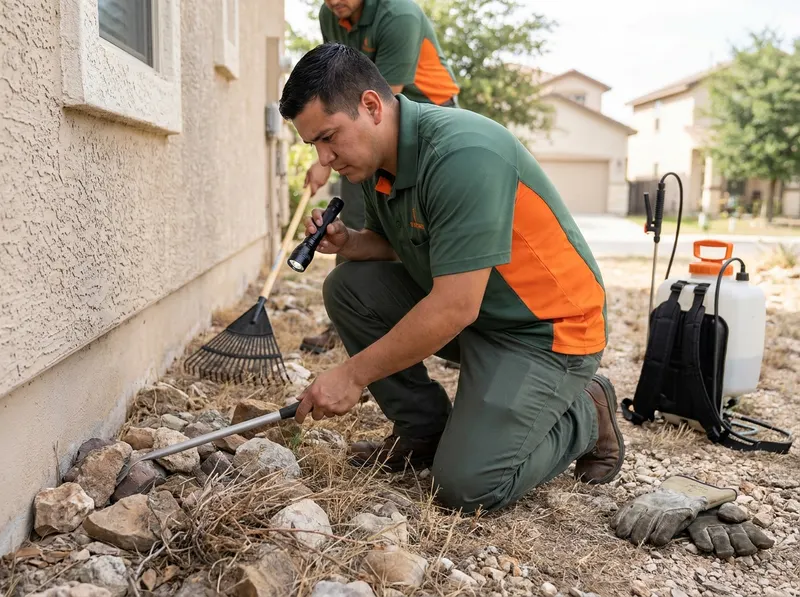
The striped bark scorpion (Texas A&M AgriLife Extension classification Centruroides vittatus) represents the only native scorpion species routinely entering Bexar County structures. Measuring approximately 2.5 inches at maturity, these arachnids do not excavate burrows. Instead, they exploit micro-fissures in native Edwards limestone, expansion joints, and the gaps beneath brick veneer weep holes. Routine perimeter chemical sprays rarely resolve infestations because scorpions walk on the tips of their tarsal claws, absorbing minimal surface residue. CedarQuill Pest Management executes a structural and ecological abatement framework designed around the natural behavior of the species.
Properties situated near the shallow soil profiles of Stone Oak, The Dominion, and Helotes Creek face elevated foraging activity between May and September, when prolonged ground surface temperatures exceed 95 degrees Fahrenheit. Seeking moisture and cooler environments, scorpions migrate from dry-stack retaining walls directly toward foundation footings. A home built on an elevated slab in Westover Hills or a historic pier-and-beam perimeter in Monte Vista presents unique entry thresholds. Addressing these vectors requires precision installation of 1/8-inch non-corrosive mesh within weep screeds, application of silicone-based elastomeric sealants along mortar joints conforming to ASTM International standards, and mechanical leveling of stacked decorative rock located within 15 feet of external walls.
Inside residential envelopes, scorpions prioritize wall voids and ceiling junctions, often gaining attic access via low-hanging live oak limbs and utility conduits. Structural integrity guidelines established by the International Code Council dictate that weep holes remain open for wall cavity ventilation and moisture drainage; standard polyurethane spray foam traps trapped condensation and accelerates structural rot. Our team applies woven wire inserts that satisfy building ventilation codes while physically denying scorpion entry. For crawlspace foundations typical in the King William Historic District, Southtown, and Alamo Heights, technicians evaluate soil-to-wood clearances guided by U.S. Department of Housing and Urban Development pest-prevention measures, eliminating the damp wood harborage where secondary prey insects proliferate.
Microclimate management forms the decisive trade-off against long-term maintenance costs. Retaining deep layers of decorative hardwood mulch directly against a foundation reduces landscape water evaporation but creates an insulated 70-degree relative-humidity zone favored by nocturnal foragers. Replacing organic ground cover within an 18-inch perimeter zone using pea gravel or bare compacted crushed granite lowers scorpion harbor density significantly. CedarQuill Pest Management pairs this physical modification with targeted desiccating dusts (such as amorphous silica gel evaluated by the U.S. Environmental Protection Agency) introduced directly into inaccessible void spaces. This integrated pest management method, aligned with the National Pest Management Association field protocols, permanently reduces ambient population pressure without degrading indoor air quality.
Every job gets a firm, written price after a free on-site visit.
For standards, safe disposal, and service guidance on pest control services in San Antonio, TX, useful references include U.S. EPA, ENERGY STAR, U.S. Dept. of Energy, Consumer.gov, U.S. Census Bureau, and Google Maps. General consumer and small-business resources are available from USA.gov, Better Business Bureau, FTC Consumer Advice, U.S. Small Business Administration, and Ready.gov.
Tell us about your striped bark scorpion habitat abatement job in San Antonio and we'll send a clear, written quote, usually the same day.
 CedarQuill Pest Management