Residential architectural styles throughout San Antonio provide optimal microclimates for nest construction by hymenopteran insects. In areas like Alamo Heights, Monte Vista, and the King William Historic District,…
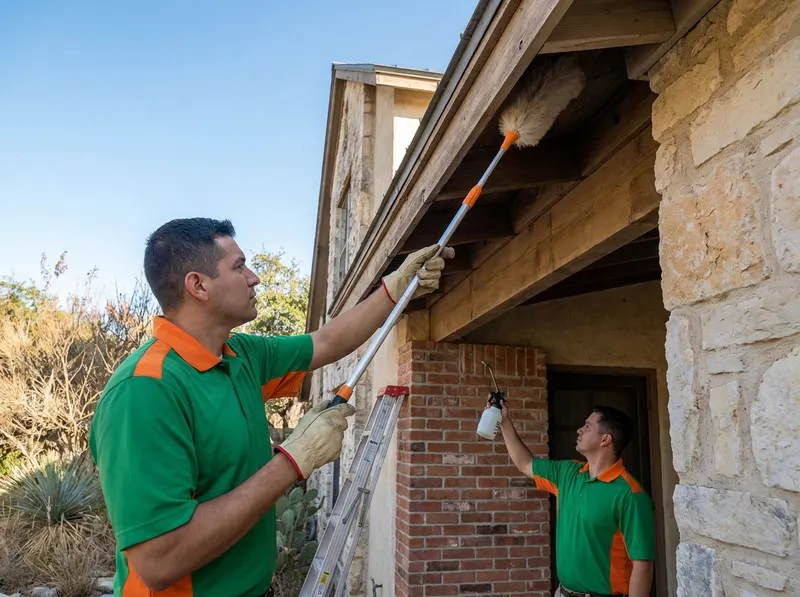
Residential architectural styles throughout San Antonio provide optimal microclimates for nest construction by hymenopteran insects. In areas like Alamo Heights, Monte Vista, and the King William Historic District, deep tongue-and-groove cedar eaves, unvented ornamental rafter tails, and shaded porch overhangs insulate colonies from direct solar radiation during triple-digit summer afternoons. In newer residential builds across Stone Oak, Westover Hills, and The Dominion, high-pitched multi-gable rooflines and open vinyl soffit returns yield sheltered transition voids where ambient temperatures hover between 85 and 95 degrees Fahrenheit. Red paper wasps build open umbrella combs beneath fascia boards, defending perimeters when roof maintenance or painting occurs within 10 feet of their nests. Mud daubers construct tubular clay structures across stucco wall interfaces and brick frieze boards, gathering silty substrate from saturated drainage zones near Helotes Creek or urban irrigation swales in Southtown.
Effective abatement requires understanding the behavioral biology of these distinct species rather than administering indiscriminate perimeter sprays. Mud daubers are solitary hunters that capture paralyzing spiders to provision larval chambers inside dried clay tubes, whereas paper wasps establish complex semi-social colonies with reproductive queens capable of stinging repeatedly when threatened. Applying standard pyrethroid surface sprays often fails to solve the infestation because dried mud tubes shelter developing pupae behind 0.25-inch thick mineral walls, while paper wasps quickly recolonize untreated timber marked by persistent lipid landing pheromones. Structural mitigation requires three sequential phases: primary mechanical knockdown using telescoping extraction rods, abrasive wire-brushing of substrate attachment points to clear residual brood combs and spider carcasses, and the localized application of a non-volatile, pyrethrin-derived microencapsulated repellent registered by the Environmental Protection Agency.
Long-term defense of the home perimeter demands architectural exclusion rather than perpetual chemical treatments. Technicians inspect roof junctions where drip edges intersect trim boards, chimney chase caps, and attic louvers complying with Texas A&M AgriLife Extension pest-proofing structural standards. Entry gaps exceeding 0.125 inches receive UV-stabilized elastomeric silicone sealants or copper wire mesh screens compliant with ASTM International standards for building envelope materials. For properties near riparian corridors or heavily irrigated landscaping in Terrell Hills and the Medical Center, nesting pressure increases between late April and September. CedarQuill Pest Management deploys specialized non-conductive extension gear tested under Occupational Safety and Health Administration electrical line clearance thresholds to address elevated dormers without inducing structural surface abrasion.
Preventative exterior maintenance preserves structural surfaces while minimizing chemical run-off into regional waterways governed by the Edwards Aquifer Authority and local guidelines outlined by the San Antonio River Authority. Property owners should note that standard high-pressure water washing does not replace targeted mechanical abatement; hydraulic blasting dissolves mud tubes into liquid silt that permanently stains light-colored limestone or modern acrylic stucco, while dispersing live spider remains into weep screeds. CedarQuill Pest Management coordinates treatments that abide by structural safety protocols certified by the National Pest Management Association and Texas pest regulatory codes enforced by the Texas Department of Agriculture, guaranteeing that attic vent access and siding materials remain undamaged during physical nest detachment.
Every job gets a firm, written price after a free on-site visit.
For standards, safe disposal, and service guidance on pest control services in San Antonio, TX, useful references include U.S. EPA, ENERGY STAR, U.S. Dept. of Energy, Consumer.gov, U.S. Census Bureau, and Google Maps. General consumer and small-business resources are available from USA.gov, Better Business Bureau, FTC Consumer Advice, U.S. Small Business Administration, and Ready.gov.
Tell us about your paper wasp & mud dauber eaves abatement job in San Antonio and we'll send a clear, written quote, usually the same day.
 CedarQuill Pest Management