Commercial kitchen vector defense serves operating food service facilities that require verifiable pest elimination without risking food-contact surface contamination. While basic monthly spray maintenance relies on…
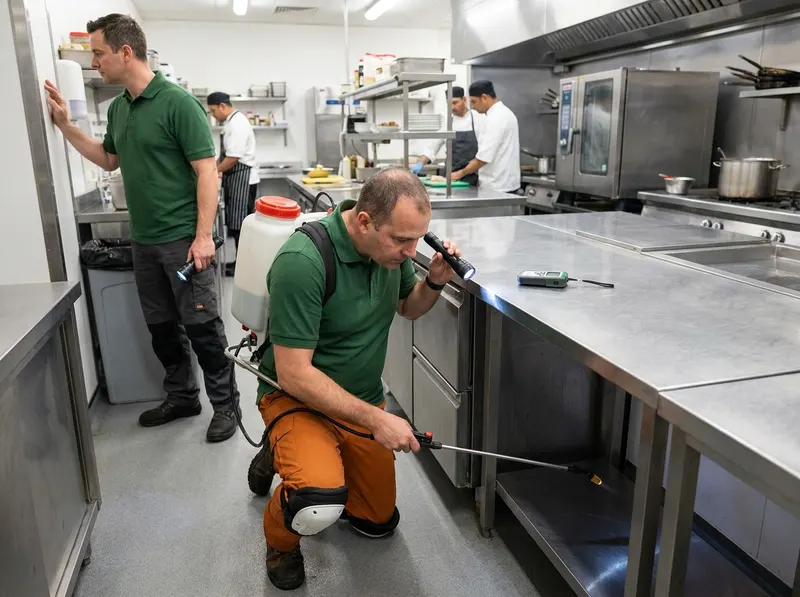
Commercial kitchen vector defense serves operating food service facilities that require verifiable pest elimination without risking food-contact surface contamination. While basic monthly spray maintenance relies on chemical repellents that temporarily displace insects deeper into hollow stainless-steel legs, motor housings, and drywall voids, vector defense operates on an environmental biology model. The trade-off between standard spraying and bio-sanitation exclusion is upfront labor: mechanical sealing and line clearing require dismantling base plates and jetting organic accumulations, but it terminates population cycles rather than masking them. Facilities subject to municipal inspections under the San Antonio Metropolitan Health District standards must maintain zero active vector activity to comply with local retail food codes.
Culinary environments throughout the River Walk hospitality sector, the Pearl district near Monte Vista, and Southtown experience intense vector pressure driven by subtropical humidity and legacy infrastructure. In historic buildings across the King William Historic District and Alamo Heights, perimeter settling creates gaps along utility penetrations where subterranean grease traps meet foundation joints. Roof rats exploit overhead utility lines and unsealed roof curbs above commercial exhaust hoods, while American cockroaches navigate through aging city municipal sewer branches. In modern commercial strip centers across Stone Oak, Westover Hills, and the Medical Center corridor, slab movement ruptures secondary tile grout, creating moist subterranean voids beneath dishwashing pits that support thriving phorid fly larvae.
1. Structural diagnostic inspection: Technicians map non-visible harborages beneath cook lines, dish pits, and grease interceptors, documenting thermal and moisture anomalies in line with FDA Food Code guidelines.
2. Bioremediation of organic sludge: Drains, floor troughs, and beverage chase lines receive dense enzymatic foams containing bacillus strains formulated to digest complex lipids, starch deposits, and bio-film layers per EPA Safer Choice biochemical directives.
3. Non-repellent perimeter barrier: Pervious void spaces behind stainless-steel cladding receive localized applications of non-volatile active compounds listed under the California Department of Pesticide Regulation active ingredient registries to break reproduction without pushing vectors into dining dining rooms.
4. Architectural exclusion sealing: Gaps greater than 0.25 inches around mop sinks, soda lines, conduits, and threshold seals are reinforced with stainless mesh and elastomeric silicone meeting NSF International non-food zone sanitation criteria.
High-volume venues in Terrell Hills, commercial centers along Helotes Creek, and private golf club facilities in the Dominion balance strict food safety protocol against demanding operational calendars. Commercial operations cannot afford off-gassing agents that require a 12-hour kitchen clearance; vector defense relies on targeted formulations registered under the EPA Federal Insecticide, Fungicide, and Rodenticide Act that leave zero volatile suspended particles. Structural sealing also ensures continuous compliance with OSHA Sanitation Standard 1910.141, ensuring employees remain free from vector-borne pathogens while preparing food.
Every job gets a firm, written price after a free on-site visit.
For standards, safe disposal, and service guidance on pest control services in San Antonio, TX, useful references include U.S. EPA, ENERGY STAR, U.S. Dept. of Energy, Consumer.gov, U.S. Census Bureau, and Google Maps. General consumer and small-business resources are available from USA.gov, Better Business Bureau, FTC Consumer Advice, U.S. Small Business Administration, and Ready.gov.
Tell us about your commercial kitchen vector defense job in San Antonio and we'll send a clear, written quote, usually the same day.
 CedarQuill Pest Management